The block in the market has a very long memory
Buy a block of panela in Paloquemao and you are holding one of the oldest processed foods on earth. Not sugar as a refinery makes it, but cane juice boiled down until it sets — a technique that reaches Colombia by way of Spain, the Atlantic islands, North Africa, Persia and, at the far end of the chain, the Ganges plain.
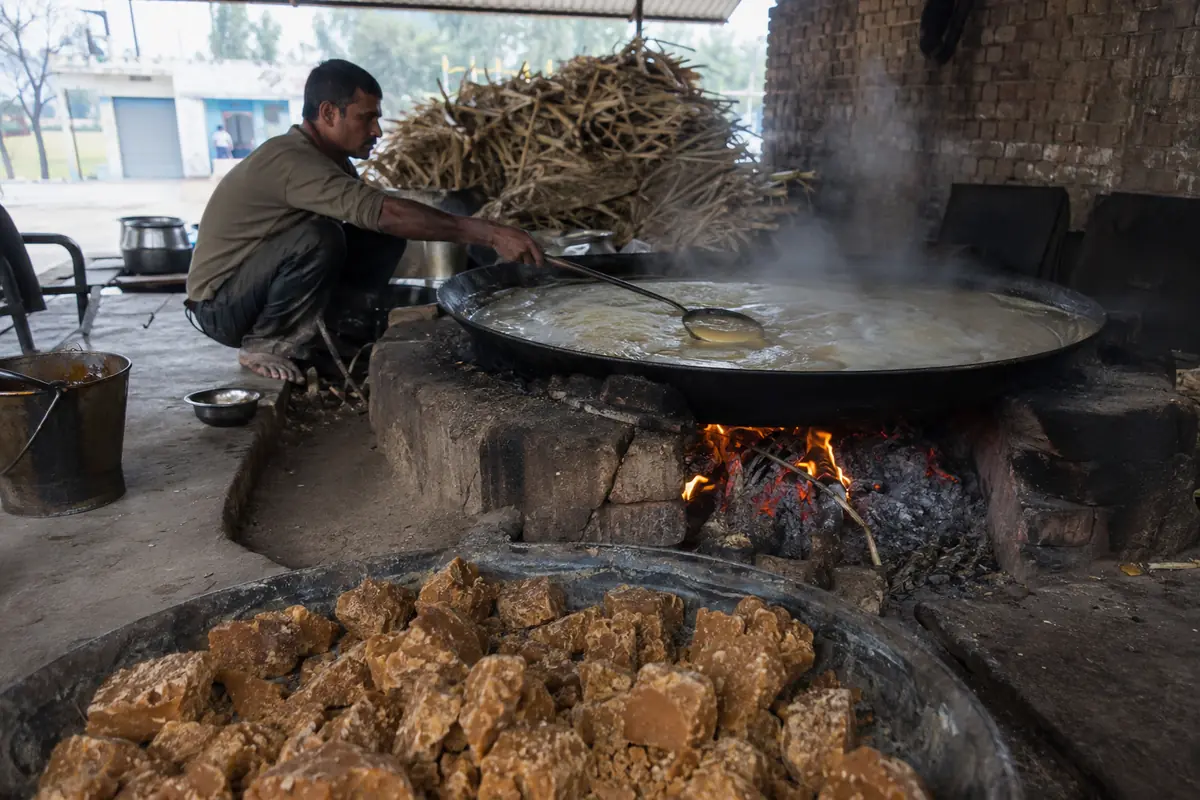
The Colombians call it panela. In northern India and Pakistan it is gur, sold in exactly the same amber lumps, made in exactly the same way: crush the cane, boil the juice in a shallow pan over a cane-fed fire, skim the froth, pour it out and let it harden. Food scientists have a joyless name that covers the whole family — non-centrifugal cane sugar, meaning nothing was ever spun out of it. Panela, gur, jaggery, the Mexican piloncillo, the Brazilian rapadura: one invention, many kitchens.
Cane came from New Guinea, but sugar came from India
Sugarcane itself is a Pacific plant. Saccharum officinarum was domesticated in New Guinea, chewed raw for its sweetness, and carried west by seafarers and traders into Southeast Asia and the Indian subcontinent.
What happened in India was different, and it is the reason any of this matters. Somewhere in the first millennium BCE, cane juice stopped being a drink and became a keepable solid. Indian texts from the Mauryan period already distinguish grades of boiled cane product — guda, the coarse dark lump, and khanda, the crumblier crystalline stuff. That second word travelled into English as candy.
This was a genuine technological leap. Fresh cane juice ferments within hours; boiled and set, it keeps for months, survives a journey, pays a debt. Every later chapter of sugar’s history — the plantations, the fortunes, the appalling human cost — depends on that one Indian discovery that sweetness could be made portable.
The word itself made the journey
You can trace the route in a single word. Sanskrit śarkarā meant gravel, then granulated sugar. It became Persian shakar, then Arabic sukkar. Arabic al-sukkar gave Spanish azúcar, Portuguese açúcar, Italian zucchero, French sucre and English sugar.
Jaggery took a different road to the same place: Sanskrit śarkarā into Malayalam cakkara, picked up by Portuguese traders on the Malabar coast as jágara, and handed on to English.
So the Spanish word for sugar that arrived in Cartagena in the sixteenth century was a Sanskrit word wearing Arabic clothes. The vocabulary crossed the ocean alongside the plant.
How the technique reached the Atlantic
Cane and the knowledge of boiling it spread westward with the expansion of the Islamic world after the seventh century, into Persia, Mesopotamia, Egypt, North Africa and eventually Muslim Spain and Sicily. Wherever irrigation could be built, cane followed.
From the Mediterranean it moved out into the Atlantic — Madeira, the Canary Islands — where Portuguese and Spanish growers refined the plantation model that would define the Americas: large estates, capital-intensive mills, and coerced labour. By the fifteenth century the Canaries were Europe’s main sugar supplier.
Then, in 1493, Columbus loaded Canarian cane onto his second voyage and planted it in Hispaniola. That is where the Colombian half of this story begins — the sugar mills of the colonial period, the enslaved Africans forced to work them, and panela riding in traders’ saddlebags as currency.
Two kitchens, one recipe
What is quietly remarkable is how little the humble version changed. Industrial sugar was transformed beyond recognition — centrifuges, bone char, refineries, a white crystal with no origin and no taste but sweet. Panela and gur simply carried on.
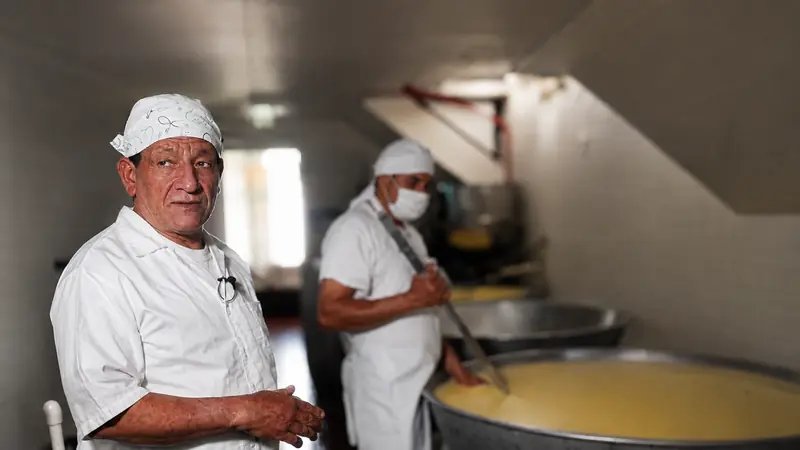
A trapiche in Santander and a workshop in Uttar Pradesh are doing the same thing today: cane in one end, fire underneath, amber blocks at the other. The moulds differ — rectangular boards in Colombia, rough hand-formed lumps in the Punjab. The product is a cousin.
So the panela in your coffee is not a Colombian invention that happens to resemble an Indian one. It is the Indian invention, carried west by traders, conquerors and colonists, and kept alive in Colombian valleys long after the rest of the world moved on to white sugar.
Taste the end of a very long road
Panela is still everywhere in Bogotá — in the aguapanela, the sweets, the coffee handed to you all morning. Our Candelaria Food Tour is a four-hour walk through the historic centre with 15 tastings, panela among them, from vendors who still work with it daily. It starts at 10:00 AM, runs in English, Spanish or Portuguese, and books online with instant confirmation.
Sources
- Mintz, S. W. (1985). Sweetness and Power: The Place of Sugar in Modern History. New York: Viking.
- Galloway, J. H. (1989). The Sugar Cane Industry: An Historical Geography from its Origins to 1914. Cambridge: Cambridge University Press.
- Daniels, C., & Menzies, N. K. (1996). Science and Civilisation in China, Vol. 6, Part 3: Agro-Industries and Forestry. Cambridge: Cambridge University Press.
- Deerr, N. (1949). The History of Sugar. London: Chapman and Hall.
- Ramos Gómez, O. G. (2005). Caña de Azúcar en Colombia. Revista de Indias, 49-78.